Adding clusters and apps
Adding a workload cluster
- Create
mgmt/aws/clusters/<region>/<env>/with acluster.yaml,kustomization.yaml(setnamePrefix), andcapi-nameref.yaml(so CAPI cross-references get the prefix applied; see the existing regions). - Label the
Clusterwithfluxcd: enabledandregion: <region>. - Register it in
mgmt/aws/clusters/<region>/kustomization.yamland add aKustomizationentry inmgmt/aws/clusters/flux-ks.yamlwithdependsOn: [capa-system]. - In
mgmt/aws/addons/flux-apps/flux-apps-rset.yaml, add the workload cluster to theResourceSetinputs(region + the live CAPI cluster name) and create the per-region bundlemgmt/aws/addons/flux-apps/ regions/<region>/(namespace,cluster-vars,flux-instancewith sync pathworkload/<region>-01,flux-github-pat.sops.yaml). - Add the cluster's
Bucket,DBInstance, and readerRoleCRs tomgmt/aws/infrastructure/workload-resources/(literal account ID and cluster name; use theservices.k8s.aws/regionannotation for non-default regions) and add the reader role tobootstrap.toml'steardown.global-iam-rolesandtests/test-bootstrap-config.py. - Create
workload/<region>-01/kustomization.yamlpointing at../base. - Run
mise run validate, commit, and push.
Adding apps to the workload clusters
workload/base/ is an intentionally empty overlay since issue #346 (the ACK
controllers and their CRs moved to the management cluster). Follow the
Podinfo pattern in workload/local-host/:
- Create
workload/base/<app>/with akustomization.yamllisting the app's manifests, and aflux-ks.yamldefining the FluxKustomization(path./workload/base/<app>; adddependsOnandwait: trueas needed; usepostBuild.substituteFrom: cluster-varsfor per-cluster values like${AWS_REGION}and${CLUSTER_NAME}). - Register the
flux-ks.yamlinworkload/base/kustomization.yaml. - Run
mise run validate, commit, and push. Every workload cluster picks it up on its next sync.
Using other providers
The management cluster is not AWS-only. Providers are declared as CAPI
operator CRs (operator.cluster.x-k8s.io/v1alpha2) under
mgmt/<environment>/capi-providers/ (for example mgmt/aws/capi-providers/ for
AWS EKS, mgmt/local-host/capi-providers/ for local Docker, and
mgmt/local-talos/capi-providers/ for Talos and Tinkerbell), one directory per
provider namespace, and registered in that environment's capi-providers/flux-ks.yaml.
The operator resolves the well-known provider names (aws, azure, gcp,
talos, k0sproject-k0smotron) from the same built-in registry clusterctl uses, so
a provider is just a typed CR with a pinned version:
mgmt/aws/capi-providers/<name>-system/
  namespace.yaml
  kustomization.yaml        # lists namespace.yaml + providers.yaml (+ secrets)
  providers.yaml            # the typed provider CR(s)
  <credentials>.sops.yaml   # optional cloud credentials, SOPS-encrypted
The Flux registration in flux-ks.yaml follows the existing entries:
dependsOn: [capi-system], decryption.provider: sops when credentials ship
in Git, and a healthChecks entry naming one CRD the provider installs so
Flux waits for it.
Contract note: this repo pins CAPI core v1.14.2, which speaks the v1beta2 contract and still accepts v1beta1-contract providers until the v1beta1 removal (tentatively CAPI v1.16, April 2027). Prefer providers that already speak v1beta2.
AWS (CAPA): the reference wiring
CAPA is the provider this repo already runs; use it as the template:
mgmt/aws/capi-providers/capa-system/providers.yamldeclaresInfrastructureProvider awsv2.13.1 withconfigSecret: aws-credentialsand the EKS feature gates (EKS=true,EKSEnableIAM=true,EKSAllowAddRoles=true,MachinePool=true).- The
aws-credentialssecret is created imperatively from ambient credentials at bootstrap/pivot time (no SOPS file required); see docs/aws.md and docs/secrets.md for the current credential flow. - Cluster definitions in
mgmt/aws/clusters/<region>/<env>/useAWSManagedControlPlane+AWSManagedMachinePool(EKS). The ACK controllers and the per-cluster AWS resource CRs run on the management cluster (mgmt/aws/infrastructure/ack-controllers/andmgmt/aws/infrastructure/workload-resources/; see docs/aws-iam.md).
Azure (CAPZ)
CAPZ v1.27.0 speaks the v1beta1 contract (accepted by CAPI v1.14 until the v1beta1 removal) and bundles Azure Service Operator (ASO) v2.19.0, which backs the managed-AKS path.
The azure environment is the worked example: mgmt/azure/ (see
azure.md). Reuse it rather than adding CAPZ to mgmt/aws/:
the provider is capi-providers/capz-system/providers.yaml
(InfrastructureProvider azure v1.27.0 with configSecret: capz-variables
carrying ADDITIONAL_ASO_CRDS), credentials are one SOPS Secret read by
both AzureClusterIdentity and ASO's credential-from annotation, and
clusters use AzureASOManagedCluster / AzureASOManagedControlPlane /
AzureASOManagedMachinePool with the ASO resources inline (their names are
literal final names: kustomize's namePrefix does not descend into
spec.resources).
GCP (CAPG + Config Connector)
CAPG v1.13.1 speaks the v1beta1 contract (accepted by CAPI v1.14 until the
v1beta1 removal). The worked example is the gcp environment: mgmt/gcp/
(see gcp.md), europe-north1 with a GKE management cluster
(europe-north1-management) and a GKE workload cluster. Reuse it rather
than adding CAPG to another environment:
- The provider is
capi-providers/capg-system/providers.yaml(InfrastructureProvider gcpv1.13.1 withconfigSecret: capg-variables; GKE and MachinePool are feature gates in the variables, not in the CR). - Credentials are one plain
external_accountSecret per consumer (capg-wif-credentialsfor CAPG,kcc-wif-credentialsfor Config Connector): Workload Identity Federation against thekropspool, the provider name templated as${GCP_WIF_PROVIDER:=mgmt}(the kind bootstrap cluster overrides it tokindthrough thegcp-wifConfigMap thewif-federatetask creates, and the pivot pinsmgmtthroughpivot-manifest-vars). No service-account key exists anywhere. - Cloud resources for the workload cluster are reconciled by the
management cluster's Config Connector (Helm chart via OCIRepository,
mgmt/gcp/infrastructure/kcc-operator/) frommgmt/gcp/infrastructure/workload-resources/(issue #560: no second Config Connector on the workload cluster), not by a CAPI add-on. - Clusters use
GCPManagedCluster/GCPManagedControlPlane/GCPManagedMachinePoolwith the literal GKEclusterNamekept as-is (kustomize'snamePrefixdoes not rename it; the CAPI cross-references get the prefix throughcapi-nameref.yaml).
Talos (CABPT + CACPPT)
Talos supplies the bootstrap and control plane providers only; pair it with
any infrastructure provider (CAPT, CAPA, CAPZ, ...) that supplies the
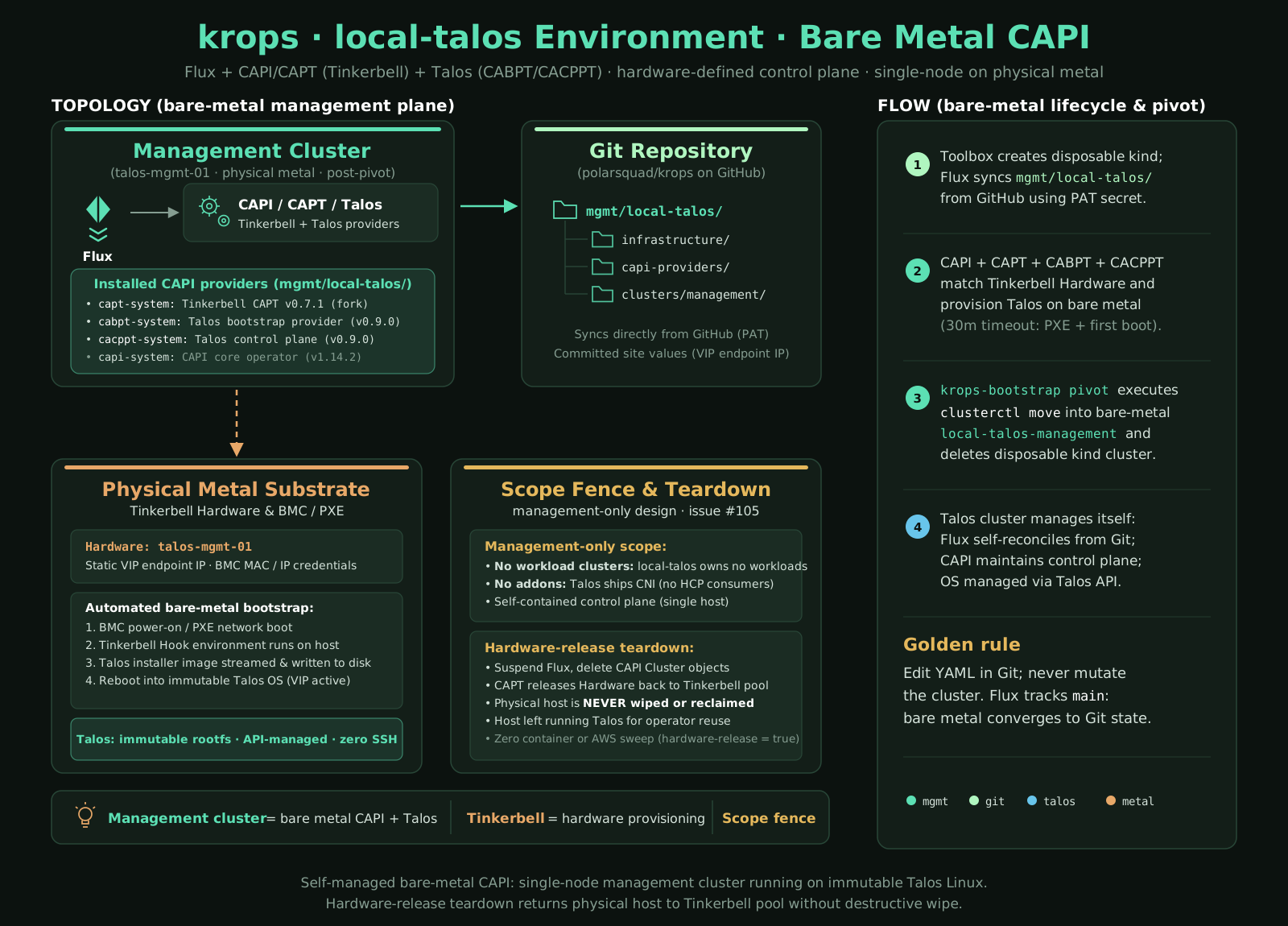
machines. The worked in-repo example is the local-talos environment:
mgmt/local-talos/ pairs the Talos providers with Tinkerbell (CAPT) to
PXE-boot a bare-metal management machine. See the architecture diagram in
docs/local-talos-infra.svg.
- Two directories, matching the upstream namespace conventions:
# mgmt/local-talos/capi-providers/cabpt-system/provider.yaml
apiVersion: operator.cluster.x-k8s.io/v1alpha2
kind: BootstrapProvider
metadata:
  name: talos
  namespace: cabpt-system
spec:
  version: "v0.9.0"
  fetchConfig:
    url: "https://github.com/sidero-community/cluster-api-bootstrap-provider-talos/releases"
The control plane provider is the same shape
(cacppt-system/provider.yaml: ControlPlaneProvider talos v0.9.0).
2. Set fetchConfig.url explicitly to the
sidero-community releases: the CAPI
operator's embedded clusterctl defaults resolve talos to the archived
siderolabs org. The sidero-community line serves the v1beta2 contract
(cluster.x-k8s.io/v1beta2: v1beta1 in the released metadata), so the
contract note above does not impose a migration deadline on it.
3. No cloud credentials: Talos machine secrets are generated per cluster by
TalosControlPlane / TalosConfig. Always set talosVersion explicitly
(e.g. v1.14) so a provider upgrade does not silently change the
generated machine config.
4. In cluster definitions, swap KubeadmControlPlane for TalosControlPlane
and KubeadmConfigTemplate for TalosConfigTemplate; the infrastructure
templates stay whatever the paired infra provider supplies.
k0smotron
k0smotron v2.1.0 is v1beta2-native and ships bootstrap, control plane, and infrastructure providers under one name:
# mgmt/aws/capi-providers/k0smotron-system/providers.yaml
apiVersion: operator.cluster.x-k8s.io/v1alpha2
kind: BootstrapProvider
metadata:
  name: k0sproject-k0smotron
  namespace: k0smotron-system
spec:
  version: "v2.1.0"
---
apiVersion: operator.cluster.x-k8s.io/v1alpha2
kind: ControlPlaneProvider
metadata:
  name: k0sproject-k0smotron
  namespace: k0smotron-system
spec:
  version: "v2.1.0"
---
apiVersion: operator.cluster.x-k8s.io/v1alpha2
kind: InfrastructureProvider
metadata:
  name: k0sproject-k0smotron
  namespace: k0smotron-system
spec:
  version: "v2.1.0"
- No cloud credentials are needed, and the cert-manager the repo already installs covers its webhooks.
- Hosted control planes:
K0smotronControlPlaneruns the child cluster's control plane as pods on the management cluster; workers come from any infra provider. - Remote machines:
RemoteMachineprovisions k0s onto existing machines over SSH (bare metal, arbitrary VMs, anywhere with no CAPI cloud provider). - Drop the
InfrastructureProviderCR if you only want hosted control planes.
After adding a provider
mise run validatebuilds every overlay, including the new directory.- Open the PR; konflate renders the blast radius (new CRDs, provider
deployments) into the PR comment and the
konflate / Rendered Flux diffcheck. - After merge, confirm the provider came up:
kubectl get pods -n <name>-systemandkubectl get <kind>providers.operator.cluster.x-k8s.io -A(e.g.infrastructureproviders).